


If you are trying to build a sustainable fitness routine, you have likely encountered conflicting advice. Some fitness influencers champion the “no days off” mentality, grinding through gruelling workouts seven days a week. Others promote minimalist routines, claiming you only need to train twice a week to see results. This avalanche of information leaves many people stuck on a fundamental question: exactly how many days a week should you work out to see real, lasting results?
For most adults, working out 3 to 5 days a week is the sweet spot for achieving optimal health, burning fat, and building muscle. This frequency allows for enough physical stimulus to force your body to adapt and grow, while simultaneously providing the crucial 24 to 48 hours of recovery time your muscles and nervous system need to repair themselves. If you are an absolute beginner, starting with 2 to 3 days a week is the safest and most effective way to build the habit without burning out.

In this comprehensive guide, we will break down what medical and fitness authorities recommend, how to adjust your workout frequency based on your specific fitness goals (such as weight loss versus muscle building), and how to perfectly structure your weekly schedule to balance exercise with vital recovery.
Understanding the Baseline: What Science Says
Before tailoring a program to specific aesthetic or athletic goals, it is important to understand the baseline requirements for general human health.
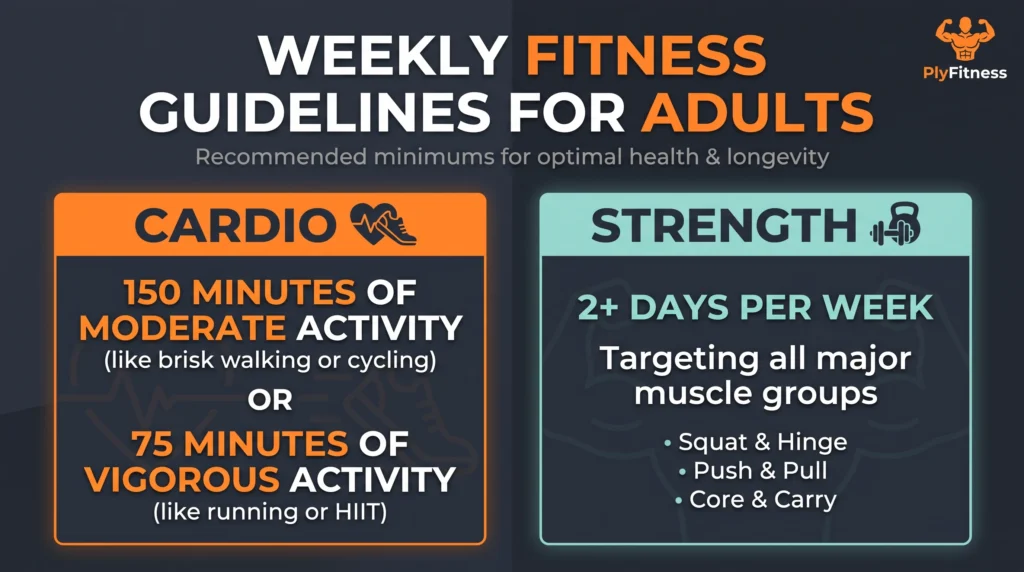
According to the Centers for Disease Control and Prevention (CDC) and the World Health Organization (WHO), adults should aim for:
- Aerobic Activity: At least 150 minutes of moderate-intensity aerobic exercise (like brisk walking or cycling) OR 75 minutes of vigorous-intensity aerobic exercise (like running or HIIT) per week.
- Strength Training: Muscle-strengthening activities that target all major muscle groups on 2 or more days a week.
If you break this down into a weekly schedule, hitting the baseline for general health usually looks like 3 to 4 days of exercise. For example, you could do two days of full-body strength training and two days of 40-minute moderate cardio. This foundational structure protects cardiovascular health, maintains bone density, and supports metabolic function.
How Many Days Should You Work Out Based on Your Goal?
While 3 to 5 days is the general rule of thumb, your specific fitness goal—whether it is losing stubborn fat, packing on muscle, or simply moving more—dictates exactly how often you should be lacing up your sneakers.
1. For Absolute Beginners (2 to 3 Days a Week)
If you have been sedentary for a long time, jumping into a 5-day-a-week program is a recipe for severe muscle soreness, injury, and eventual burnout.
- The Strategy: Start with 2 to 3 days of full-body strength training or light circuit training, with at least one rest day in between each session (e.g., Monday, Wednesday, Friday).
- Why it works: Your nervous system needs time to adapt to new movement patterns. Three days a week builds the habit of exercising without overwhelming your body’s recovery capacity.
2. For General Health and Longevity (3 to 4 Days a Week)
If your primary goal is to feel energized, improve your blood markers, and stay mobile, moderate frequency is your best friend.
- The Strategy: Aim for 3 to 4 days a week, evenly splitting your time between cardiovascular work and resistance training.
- Why it works: This frequency easily satisfies the WHO physical activity guidelines, keeps your heart healthy, and ensures your joints and muscles stay strong enough to handle daily life activities with ease.
3. For Weight Loss and Fat Burning (4 to 5 Days a Week)
Weight loss ultimately comes down to being in a caloric deficit (burning more calories than you consume). Working out more frequently helps increase your total daily energy expenditure.
- The Strategy: Work out 4 to 5 days a week. A highly effective split is three days of strength training to preserve lean muscle mass (which keeps your metabolism high) and two days of cardiovascular exercise to burn additional calories and improve heart health.
- Why it works: Strength training shapes your body, while cardio helps tip the scales on energy balance.
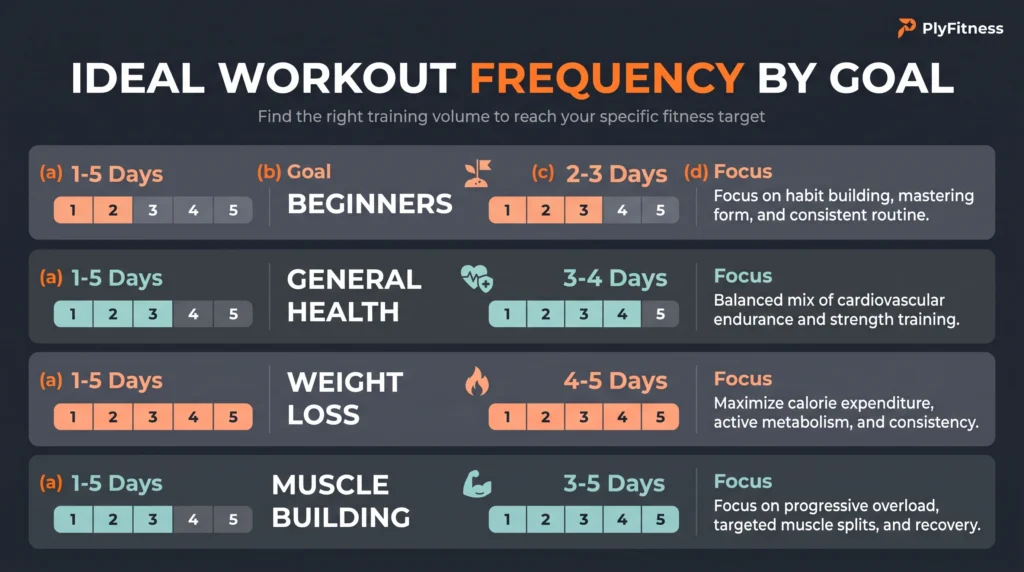
4. For Muscle Building and Hypertrophy (3 to 5 Days a Week)
To build muscle, you must subject your muscles to progressive overload and then give them time to repair. Training the same muscle group every day will actually stall your progress.
- The Strategy: 3 to 5 days a week of dedicated resistance training. If you train 3 days, do full-body workouts. If you train 4 or 5 days, use an “Upper/Lower” split or a “Push/Pull/Legs” split to ensure each muscle group gets hit twice a week with adequate rest in between.
- Why it works: Muscle protein synthesis remains elevated for 24 to 48 hours after lifting weights. Hitting each muscle group twice a week optimizes this growth window without causing overtraining.
How to Structure Your Weekly Workout Schedule
Knowing how many days to work out is only half the battle; knowing how to organize those days prevents you from wearing yourself down. A well-designed routine balances different types of physical stress.
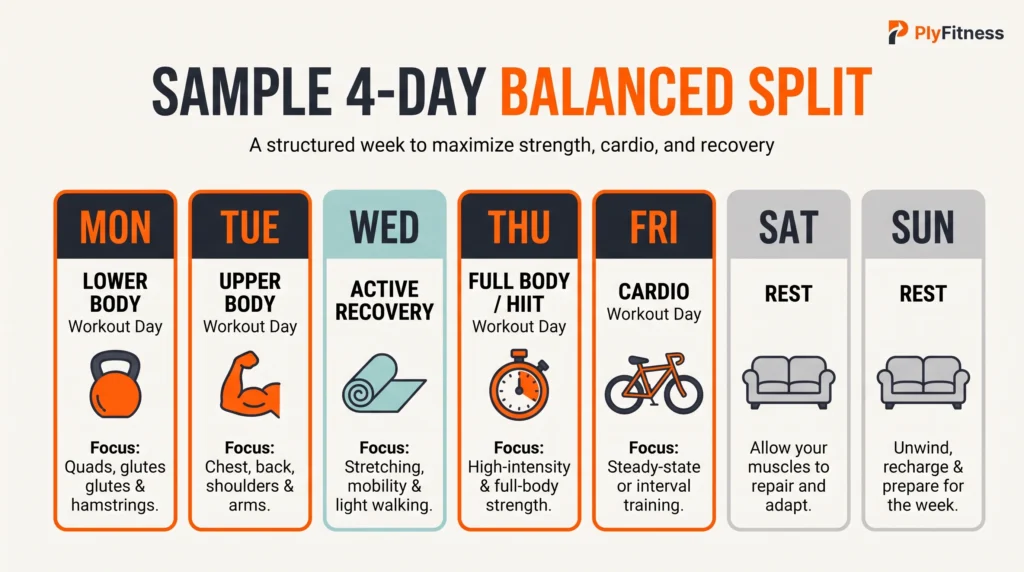
Example 4-Day Balanced Split:
- Monday: Lower Body Strength Training (Squats, Lunges, Deadlifts)
- Tuesday: Upper Body Strength Training (Push-ups, Rows, Overhead Presses)
- Wednesday: Active Recovery (Brisk walking, yoga, or light stretching)
- Thursday: Full Body Circuit or High-Intensity Interval Training (HIIT)
- Friday: Moderate Steady-State Cardio (Cycling, Jogging, Swimming)
- Saturday & Sunday: Rest and Leisurely Movement
This structure ensures that your muscles get the recovery they need. For instance, while your lower body is recovering on Tuesday, your upper body is doing the work.
The Crucial Role of Rest Days
The fitness industry often glorifies exhaustion, but scientifically, rest days are when the magic happens. When you lift weights or perform intense cardio, you are actually creating micro-tears in your muscle fibers and stressing your central nervous system.
You do not get stronger in the gym; you get stronger while you are resting on the couch or sleeping in your bed. During rest days, your body repairs those micro-tears, building the muscle tissue back denser and stronger than it was before.
Working out 7 days a week interrupts this healing process. If you constantly break down the tissue without allowing it to repair, you will experience diminishing returns, persistent fatigue, and a high likelihood of injury.
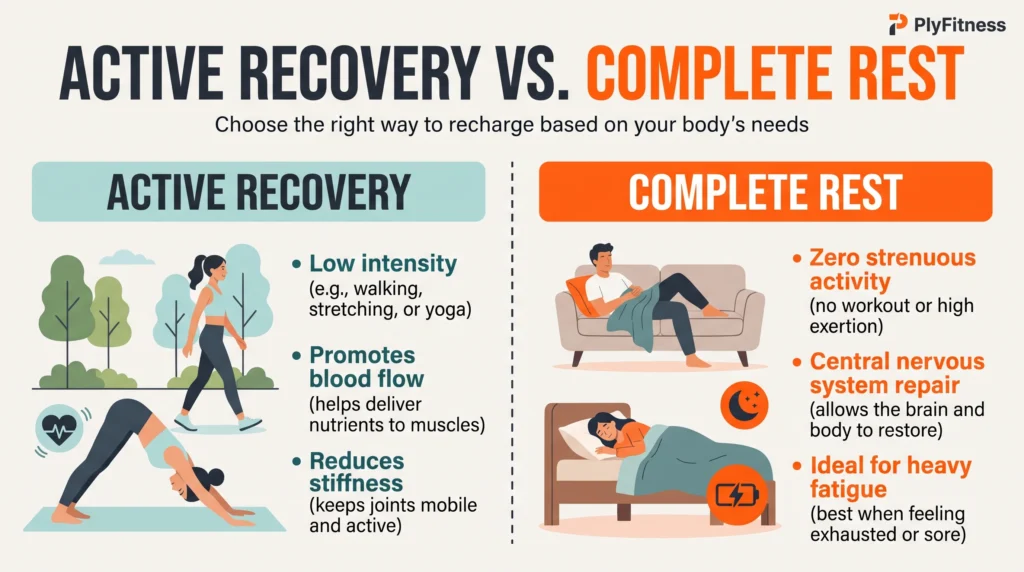
Active Recovery vs. Complete Rest
Rest does not necessarily mean staying in bed all day.
- Complete Rest: Doing absolutely no strenuous physical activity. This is recommended if you are feeling highly fatigued, sore, or are fighting off an illness.
- Active Recovery: Engaging in low-intensity movement that promotes blood flow without taxing the muscles or nervous system. Examples include a 30-minute walk, restorative yoga, or casual swimming. Active recovery helps flush out metabolic waste and reduces muscle stiffness.
Signs You Are Working Out Too Often (Overtraining)
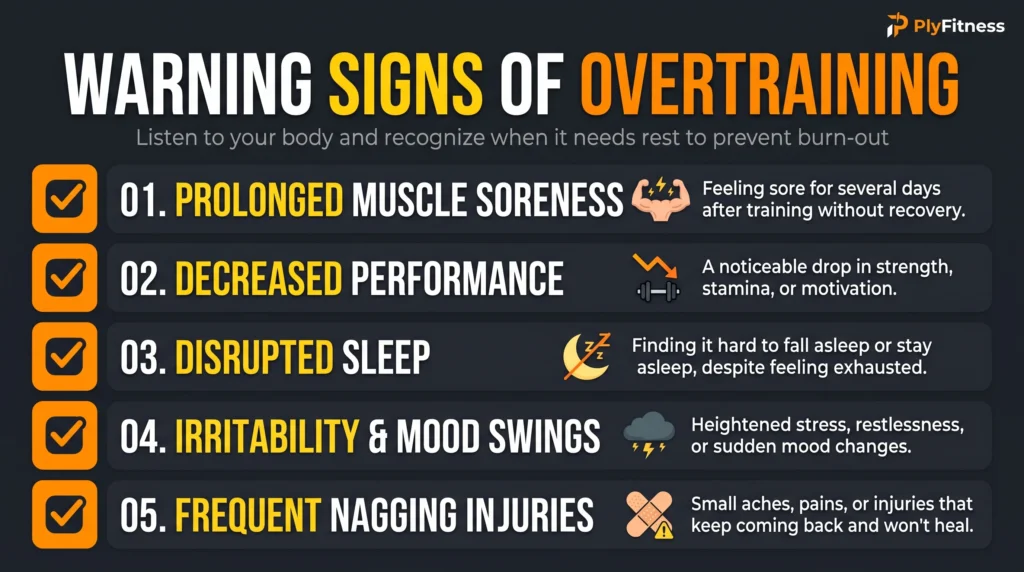
If you ignore rest days and push your workout frequency too high, your body will eventually push back. Overtraining syndrome is a serious condition that can derail your fitness progress for months. Watch out for these common warning signs that you need to reduce your workout days:
- Prolonged Muscle Soreness: While some soreness is normal, muscles that ache intensely for more than 3 or 4 days indicate inadequate recovery.
- Plateauing or Losing Strength: If the weights you normally lift suddenly feel incredibly heavy, or your running times are getting slower despite working out more, your central nervous system is fatigued.
- Disrupted Sleep: Paradoxically, extreme physical exhaustion often leads to insomnia or restless sleep due to elevated cortisol (stress hormone) levels.
- Mood Swings and Irritability: Overtraining drastically affects your hormones, often leaving you feeling unmotivated, anxious, or unusually irritable.
- Frequent Illness or Nagging Injuries: A stressed body has a weakened immune system. If you are constantly catching colds or dealing with minor joint aches, it is time to take a step back.
Conclusion: Finding Your Sustainable Rhythm
So, how many days a week should you work out? Ultimately, the best workout schedule is the one you can stick to consistently over months and years. For the vast majority of people, dedicating 3 to 5 days a week to structured exercise yields the best physical and mental results while still leaving room for life, work, and vital recovery.
Start where you are. If you currently do not exercise at all, commit to two days a week. Once that feels like a natural part of your routine, add a third day. Focus on the quality of your workouts and the quality of your rest rather than simply chasing a high number of gym days. Listen to your body, prioritize your recovery, and you will build a healthy, resilient physique that lasts a lifetime.
Frequently Asked Questions (FAQs)
Is working out 3 days a week enough to see results?
Absolutely. Working out 3 days a week is highly effective, especially if you focus on full-body resistance training and compound movements. This frequency allows you to stimulate all major muscle groups sufficiently while guaranteeing adequate recovery time, making it ideal for beginners and busy individuals.
Should I do cardio and strength training on the same day?
You can do both on the same day if you are short on time. However, to maximize your energy, it is generally recommended to do strength training first while your muscles are fresh, followed by cardio. Alternatively, separating them into different days allows you to give 100% effort to each discipline.
Is it bad to work out every single day?
Working out intensely 7 days a week is generally not recommended as it drastically increases the risk of overtraining, burnout, and injury. Your body requires rest to repair muscle tissue. If you want to move every day, incorporate 2 to 3 days of light active recovery (like walking or mobility work) rather than heavy lifting or intense cardio.
How long should my workouts last?
A highly effective workout does not need to take hours. For most people, 45 to 60 minutes is plenty of time to complete a warm-up, the main strength or cardio routine, and a cool-down. If your workouts take much longer, you may be resting too long between sets or performing unnecessary exercises.
What should I do if I miss a scheduled workout day?
Do not panic or double up your workouts the next day to “punish” yourself. Simply pick up where you left off on your next scheduled day. Consistency over a year is what creates results, not perfection in a single week.
Do I burn more fat if I work out more days a week?
Working out more days increases your total weekly calorie expenditure, which can aid in fat loss. However, fat loss is primarily driven by nutrition (maintaining a caloric deficit). If you work out 6 days a week but overeat, you will not lose fat. Focus on a balanced 4-to-5-day routine paired with a healthy diet for optimal fat loss.