

Taking the first step toward a healthier lifestyle can feel overwhelming, especially when you are trying to figure out how to start exercising at home without a gym membership, complex equipment, or prior experience. If you are wondering how to build strength, improve your cardiovascular health, and create a sustainable routine from your living room, you are in the right place.
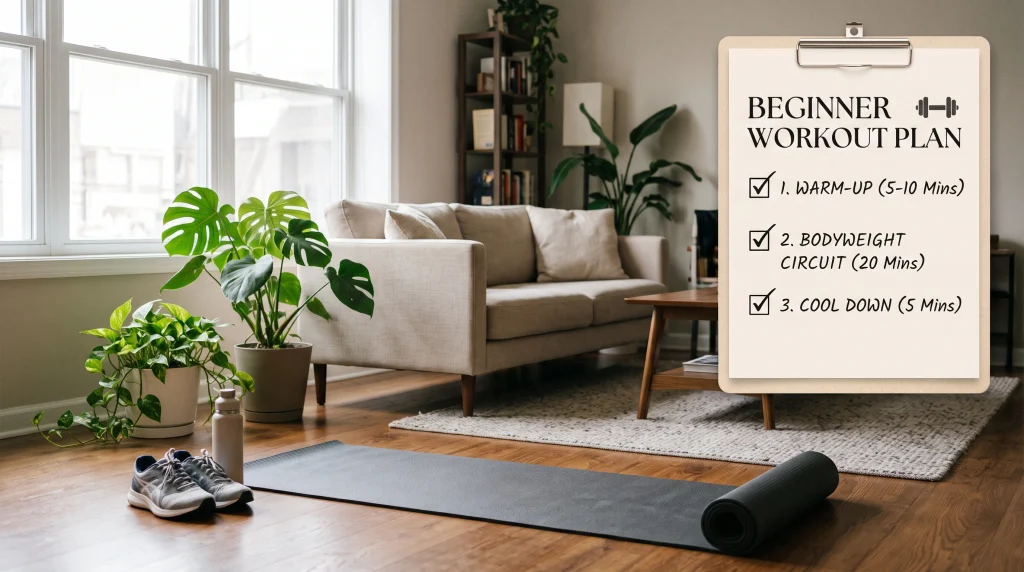
To start exercising at home, you need a simple, equipment-free routine that focuses on fundamental bodyweight movements. A basic beginner workout plan at home should consist of a 5-minute dynamic warm-up, a 15 to 20-minute circuit of foundational exercises (like squats, modified push-ups, and planks), and a 5-minute cooldown. Doing this just three times a week is enough to build a lifelong fitness habit.
In this comprehensive guide, we will walk you through a complete, step-by-step beginner workout plan designed specifically for the home environment. We will cover everything from setting up your space and learning proper exercise form to structuring your week for maximum, sustainable results.
Why Exercising at Home is Perfect for Beginners
Before diving into the actual movements, it is important to understand why home workouts are an excellent starting point. According to the World Health Organization (WHO), adults should aim for at least 150 to 300 minutes of moderate-intensity aerobic physical activity, or 75 to 150 minutes of vigorous-intensity activity per week, alongside muscle-strengthening activities twice a week.
Hitting these benchmarks does not require a gym. Home workouts offer distinct advantages:
- Zero Commute: Removing the travel time to and from a gym drastically lowers the barrier to entry, making you much more likely to stick to your routine.
- Privacy and Comfort: Gym anxiety is a real barrier for many beginners. At home, you can focus entirely on learning proper form without worrying about who is watching.
- Cost-Effective: You do not need expensive memberships or high-end equipment. Your body weight provides all the resistance you need to build initial strength and endurance.
- Ultimate Flexibility: Whether you have 15 minutes before your morning shower or 20 minutes while watching television in the evening, home workouts fit into your schedule, not the other way around.
How to Prepare for Your Home Fitness Routine
Success in fitness is rarely about motivation; it is about preparation and habit formation. Set yourself up for success by establishing a solid foundation before you even do your first squat.
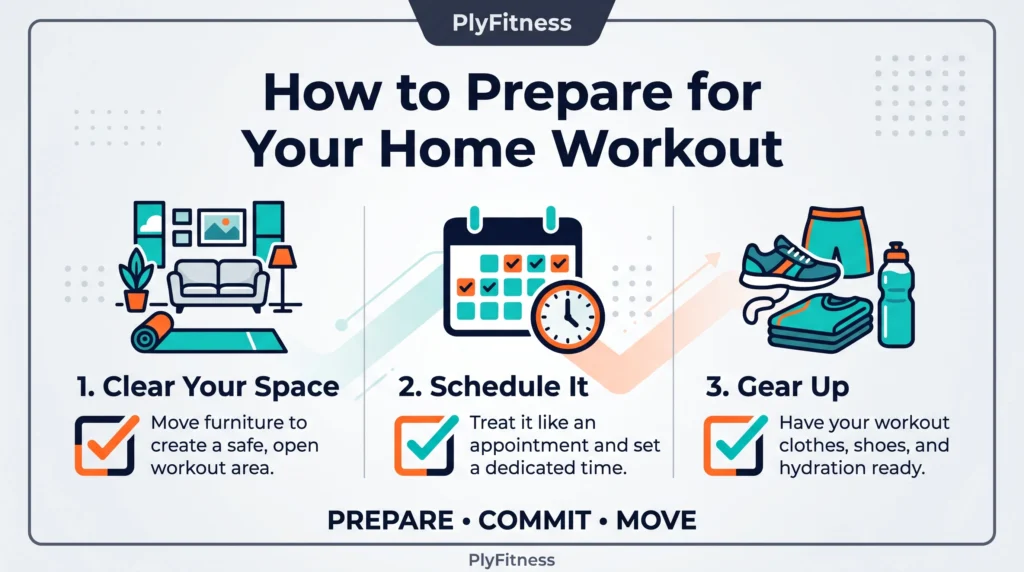
1. Carve Out Your Fitness Zone
You do not need a dedicated home gym, but you do need enough floor space to lie down fully and extend your arms in every direction. Clear away any tripping hazards like rugs or coffee tables. Having your workout mat unrolled in a specific corner can act as a powerful visual cue that reminds you to exercise.
2. Schedule Your Workouts Like Appointments
Do not leave your workouts to chance. Treat your beginner workout plan at home with the same respect as a professional meeting. If you plan to work out on Monday, Wednesday, and Friday at 7:00 AM, put it in your calendar.
3. Wear the Right Gear
Even if you are in your living room, change into proper workout clothes and athletic shoes (unless you are doing a strictly barefoot mat routine like yoga). Dressing the part triggers a psychological shift that tells your brain it is time to work hard.
The Complete Beginner Workout Plan at Home
This routine is a full-body circuit. A circuit means you will perform one exercise after another with minimal rest in between. Once you complete all the exercises, you rest, and then repeat the entire circuit.
Phase 1: The Dynamic Warm-Up (5 Minutes)
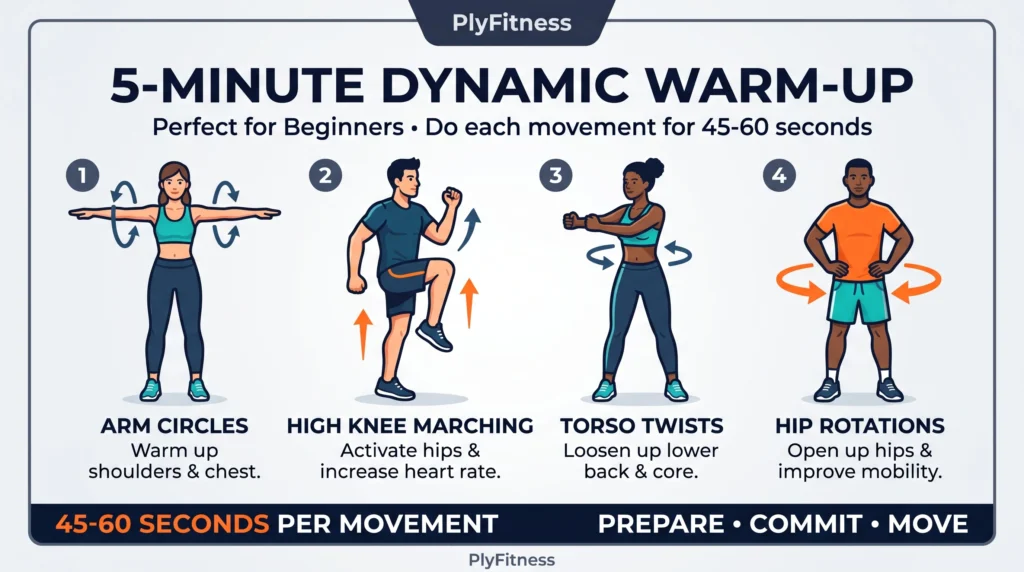
Never skip the warm-up. Warming up increases blood flow to your muscles, lubricates your joints, and significantly reduces the risk of injury. Perform each of these movements for 45 to 60 seconds:
- Arm Circles: Stand tall and extend your arms out to the sides. Make small forward circles, gradually getting larger. Reverse the direction after 30 seconds.
- High Knees (Marching): March in place, bringing your knees up as high as your hips while pumping your arms.
- Torso Twists: Stand with feet shoulder-width apart. Gently twist your upper body from left to right, letting your arms swing naturally.
- Hip Rotations: Place your hands on your hips and make large circles with your hips, like you are using a hula hoop.
Phase 2: The Full-Body Bodyweight Circuit (15-20 Minutes)
Perform each exercise for 30 seconds, followed by 30 seconds of rest. Once you finish all five exercises, rest for 60 to 90 seconds. Aim to complete 3 total rounds.
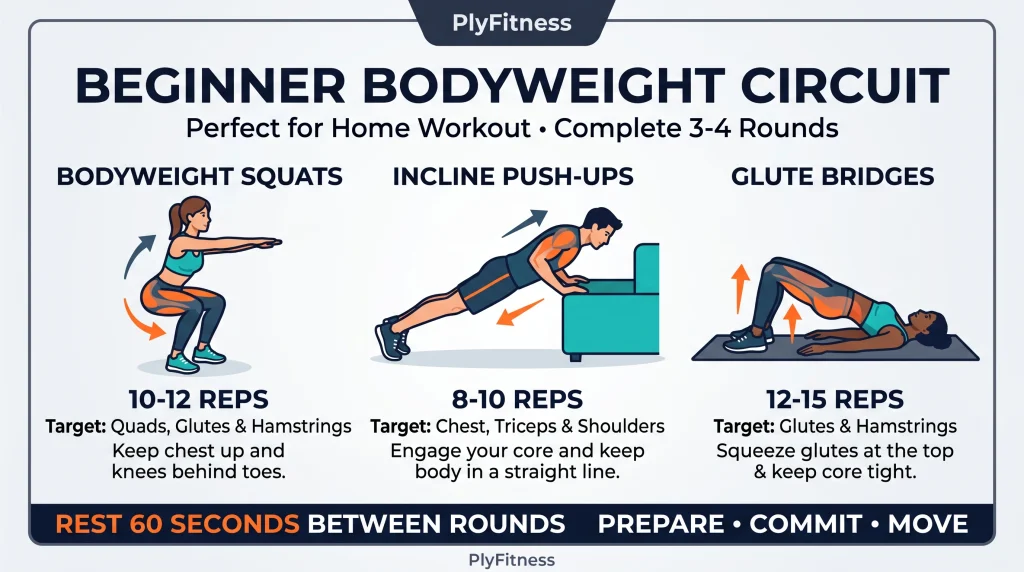
1. Bodyweight Squats (Lower Body & Core)
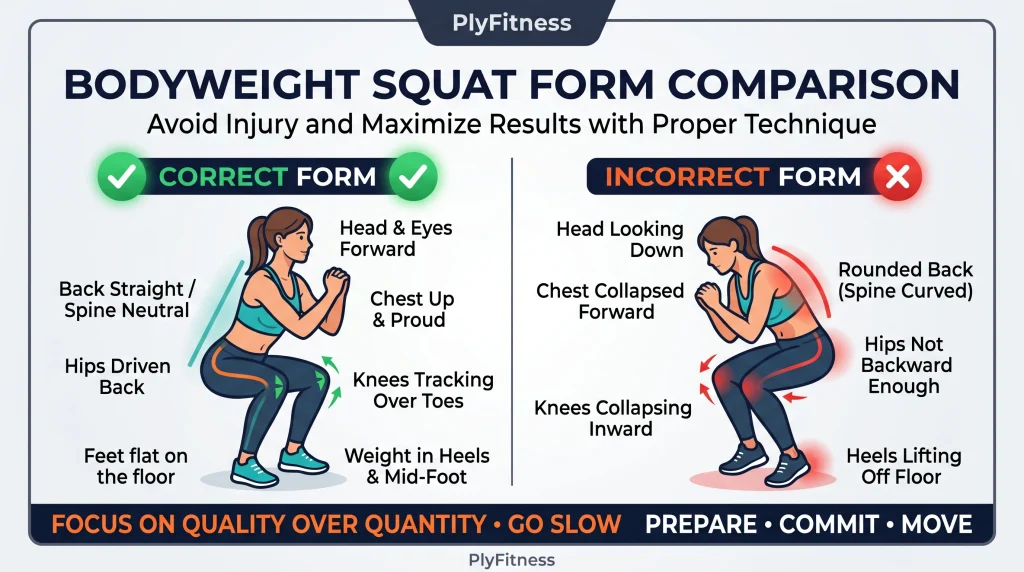
- How to do it: Stand with your feet slightly wider than shoulder-width apart. Keep your chest up and core engaged. Push your hips back and bend your knees as if you are sitting in a chair. Lower yourself until your thighs are parallel to the floor (or as low as your mobility allows). Push through your heels to return to the starting position.
- Pro Tip: Ensure your knees track in line with your toes and do not collapse inward.
2. Incline Push-Ups or Knee Push-Ups (Chest, Shoulders, Triceps)
- How to do it: Standard push-ups are incredibly challenging for beginners. Instead, place your hands on a sturdy elevated surface (like a couch, bench, or countertop) slightly wider than shoulder-width. Lower your chest to the surface, keeping your body in a straight line from head to heels. Push back up. Alternatively, perform these on the floor from your knees.
- Pro Tip: Do not let your lower back sag. Keep your glutes squeezed and your core tight.
3. Glute Bridges (Glutes & Hamstrings)
- How to do it: Lie on your back with your knees bent and feet flat on the floor, hip-width apart. Press your heels into the floor and squeeze your glutes to lift your hips toward the ceiling. Pause at the top, forming a straight line from your knees to your shoulders. Slowly lower back down.
- Pro Tip: Feel the work in your glutes, not your lower back.
4. Reverse Lunges (Legs & Balance)
- How to do it: Stand tall. Take a large step backward with your right foot and lower your hips until both knees are bent at a 90-degree angle. Your back knee should hover just above the floor. Push off your back foot to return to the start, then alternate legs.
- Pro Tip: Keep your front heel glued to the floor for stability.
5. Plank (Core Stabilization)
- How to do it: Place your forearms on the floor with your elbows directly under your shoulders. Extend your legs behind you, resting on your toes. Your body should form a straight line. Squeeze your core, glutes, and thighs. Hold this position.
- Pro Tip: If a standard plank is too difficult, drop your knees to the floor while maintaining a straight line from your head to your knees.
Phase 3: The Cool-Down (5 Minutes)
Cooling down lowers your heart rate and helps prevent muscle stiffness. Spend 5 minutes performing static stretches. Focus on holding each stretch for 30 seconds without bouncing. Great beginner stretches include the child’s pose, seated hamstring stretch, and chest opening stretch against a doorway.
Your Weekly Beginner Workout Schedule
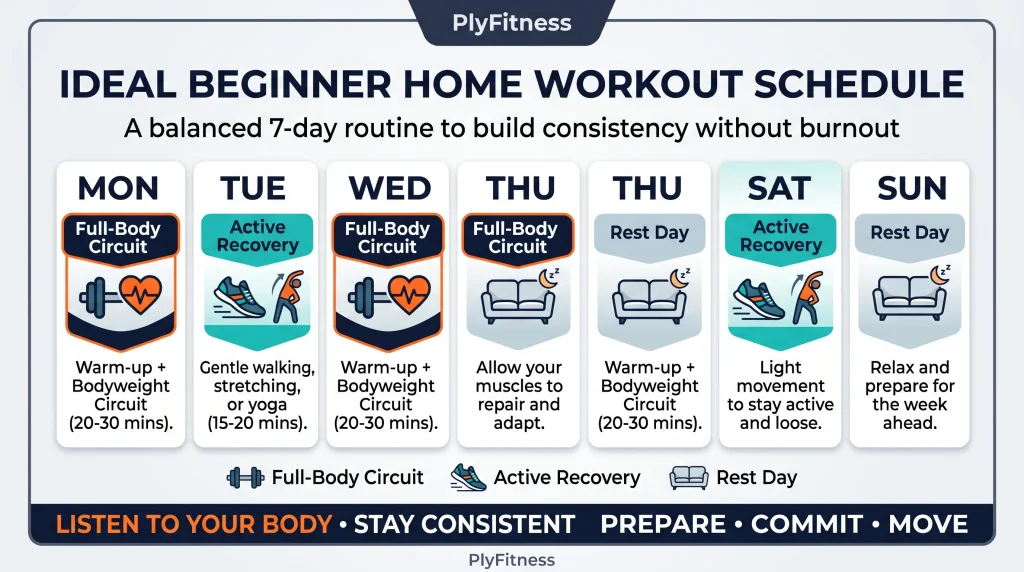
To see progress, consistency is more important than intensity. When starting out, aim for three full-body workouts a week, allowing for adequate rest days in between. Your muscles grow and recover during rest, not during the workout itself.
- Monday: Full-Body Circuit (3 Rounds)
- Tuesday: Active Recovery (A 20-minute brisk walk or light yoga)
- Wednesday: Full-Body Circuit (3 Rounds)
- Thursday: Rest
- Friday: Full-Body Circuit (3 Rounds)
- Saturday: Active Recovery (A longer walk, biking, or swimming)
- Sunday: Full Rest and Meal Prep
Essential Safety Tips and Common Mistakes
Starting a fitness journey is exciting, but doing too much too soon can lead to burnout or injury. Keep these foundational E-E-A-T (Experience, Expertise, Authoritativeness, Trustworthiness) safety guidelines in mind:
- Consult Your Doctor First: If you have pre-existing medical conditions, cardiovascular issues, or previous musculoskeletal injuries, consult a healthcare provider before beginning any new exercise regimen.
- Form Over Speed: The most common beginner mistake is rushing through movements to get them over with. Moving slowly allows you to build a mind-muscle connection and ensures the correct muscles are doing the work.
- Breathe: It sounds simple, but many beginners hold their breath during difficult parts of an exercise. A general rule of thumb is to exhale during the hardest part of the movement (the exertion phase) and inhale during the easier part.
- Listen to Your Pain Signals: Muscle fatigue and a slight burning sensation (the “burn”) are normal. Sharp, sudden, or joint-specific pain is not. If a movement causes sharp pain in your knees, lower back, or shoulders, stop immediately.
Conclusion: Consistency is Your Greatest Asset
Learning how to start exercising at home does not require perfection; it requires persistence. The beginner workout plan at home provided in this article is designed to be accessible, safe, and highly effective for building foundational strength. Start with three days a week, focus deeply on your form, and give yourself grace on the days when you feel less motivated. The goal is not to train like a professional athlete on day one; the goal is to prove to yourself that you can show up for your health consistently. Roll out your mat, clear your living room, and take that first step today.
Frequently Asked Questions (FAQs)
How long should a beginner workout last?
A beginner workout should last between 20 and 30 minutes. This provides enough time to complete a warm-up, a full-body circuit, and a cool-down without overwhelming your central nervous system.
Do I need equipment to start exercising at home?
No equipment is necessary to start. Bodyweight exercises like squats, push-ups, and lunges provide more than enough resistance to build foundational strength and improve cardiovascular fitness in beginners.
How soon will I see results from home workouts?
While you may feel more energetic and sleep better within the first week, noticeable physical changes in muscle tone and endurance typically take 4 to 8 weeks of consistent training (exercising 3 times a week).
What if I can’t do a standard push-up?
Standard push-ups are an advanced movement. Beginners should start with wall push-ups, incline push-ups (hands on a counter or sturdy chair), or knee push-ups on a soft mat to gradually build chest and triceps strength.
Is it normal to be very sore after my first workout?
Yes, Delayed Onset Muscle Soreness (DOMS) is completely normal for beginners and usually peaks 24 to 48 hours after exercise. Gentle walking, hydration, and light stretching can help alleviate the stiffness.
How do I progress when the bodyweight exercises become too easy?
Once you can easily complete 3 rounds of the circuit with minimal fatigue, you can progress by adding more repetitions, slowing down the tempo of the movements, or incorporating household items (like a heavy backpack or water jugs) for extra resistance.